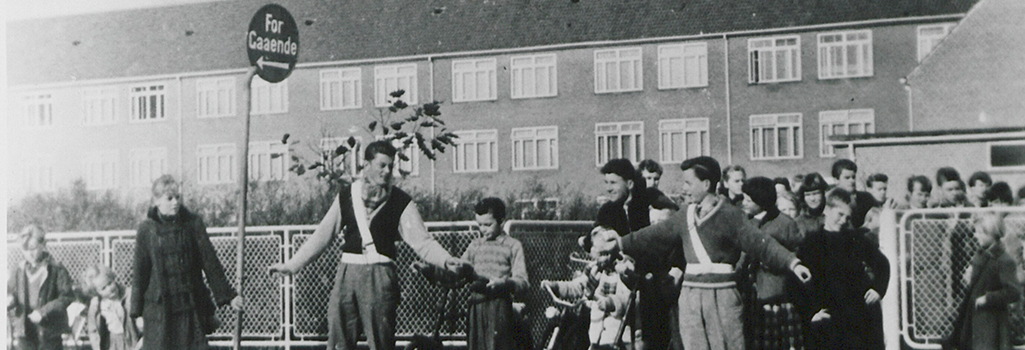
I årene mellem 1945 og 1975 ændrede den danske folkeskole sig markant. En skole i nationens, religionens og disciplinens tjeneste blev til velfærdsstatens skole med vægt på demokrati og lige muligheder for alle børn. Det skete i lyset af sociale og demografiske forandringer, den kolde krig, velfærdsstatens og industrisamfundets fremvækst, mobiliseringen af intelligensreserverne og 60’ernes økonomiske boom og kulturelle forandringer. Udviklingen var et resultat af en livlig debat, understøttet af bl.a. oprettelsen af forsøgsskolen i Emdrup i 1948, indsættelse af forsøgsparagraffer i skolelovgivning og læreruddannelse samt etablering af Folkeskolens forsøgsudvalg i 1958, betænkninger og rapporter. Projektets formål er at undersøge hvordan utopier, ideer og visioner om fremtidens gode skole med barnet i centrum og med lige muligheder for alle børn opstod, blev forhandlet, bestridt og måske/måske ikke blev realiseret i skolens hverdagspraksis. Denne viden er ikke indsamlet tidligere. I fire indbyrdes knyttede projekter om skoleforsøg, læreruddannelse, skolebyggeri og alternative skoler vil vi undersøge de utopier, forventninger og lidenskaber, der igennem hverdagens arbejde og eksperimenter gav periodens aktører mod og tro på, at det var muligt at forandre skolen. Ved at gå helt tæt på periodens eksperimenter vil projektet skabe en ny forståelse af skolereformer som komplekse, indviklede – og potentielt også modstridende – hverdagsprocesser, der ikke blot indebærer ændringer af skolens indhold og organisering, men også af de affektive, rumlige og kropslige relationer mellem lærere, forældre og elever.
Projektperiode: 1.4.2024 - 1.8.2027
Projektet er finansieret af Danmarks Frie Forskningsfond, DFF | Kultur og Kommunikation
Join us in our second online dialogue, where we will explore the study of school reforms from a historical perspective. This involves theoretical and methodological discussions about how to conceptualize reform and the differences that arise when studying it from the top down or from an everyday perspective. This potentially involves reformulating what constitutes educational policy, identifying key stakeholders/actors and reflect on impact and context. Finally, we ask how reform processes and the actors involved might empirically differ when examined across various school systems, countries and time periods.
Lead: Associate Professor Katharina Sass, University in Bergen, Norway
Speaker: Lecturer Anja Giudici, School of Social Sciences, Cardiff University, UK
Date Tuesday the 2nd of December 2025
Time: 9 am – 11.30 am (CET/CEST)
Zoom-link: https://aarhusuniversity.zoom.us/j/66145476801?pwd=gWc11r3hvg0lDclVWTpuPJKPE9ukG9.1
Katharina Sass will lead the dialogue and will begin the dialogue by discussing her approach to studying education policy and reform in the Norwegian and German contexts. She will draw on examples from her work on the politics of comprehensive school reforms in the post-war decades, as well as from her current comparative research on the politics of school choice in European cities. The focus of the talk will be on how to map actors involved in policy processes and examine their power resources and political strategies. Following this, Anja Giudici will consider the various ways in which teachers, political parties, providers and other stakeholders have shaped education policy in Western democracies, drawing on her work in the field of comparative and historical education politics. Giudici’s presentation will focus on how to capture the impact of these actors' collective and individual strategies and relationships on education policy in different historical contexts. Finally, examples and theoretical discussions from the research project 'Edutopias: Reforms of Everyday School Practices: Denmark, 1945–1975', which is based at Aarhus University in Denmark (EDUTOPIAS) will be brought to the table for discussion.
We invite scholars and other interested participants to join this online seminar, with the aim of sharing experiences, engaging in discussion, and refining the work on affect methodologies among historians of education.
Katharina Sass is an Associate Professor of Sociology at the University of Bergen in Norway. Her research focuses on the comparative-historical analysis of education politics and reforms, and more recently on the politics of salmon production. In 2022, she published the book 'The Politics of Comprehensive School Reforms'. Cleavages and Coalitions, which examines school politics in Germany and Norway during the post-war period.
Anja Giudici is a Lecturer in Education at Cardiff University in the UK. Her research explores the comparative politics and history of education, focusing on how political and professional ideologies, identities, and interests interact to shape education policy and practice. She has published on the politics of educational structures, the education politics of the European far right, and on the participation and labor of teachers and other education personnel.
This is the second in a series of four digital dialogues, organised as part of the research project EDUTOPIAS based at Aarhus University, Denmark. In this research project Ning de Coninck-Smith, Lisa Rosén Rasmussen, Pernille Svare Nygaard, and Kamilla Ane Petersen study the Danish school reforms introduced 1945-1975 from the perspective of the promising spaces of teacher training, school experiments, school architecture and independent small schools. The aim is to develop a new understanding of reforms as complex and conflicting everyday processes, which not only address the curriculum or school structure, but also change the affective, spatial, and embodied relations between teachers, parents, and students.
If you have any questions about the digital dialogue, or if you encounter any technical difficulties with the Zoom link on the day of the event, please get in touch with Lisa Rosén Rasmussen (lisa@edu.au.dk).